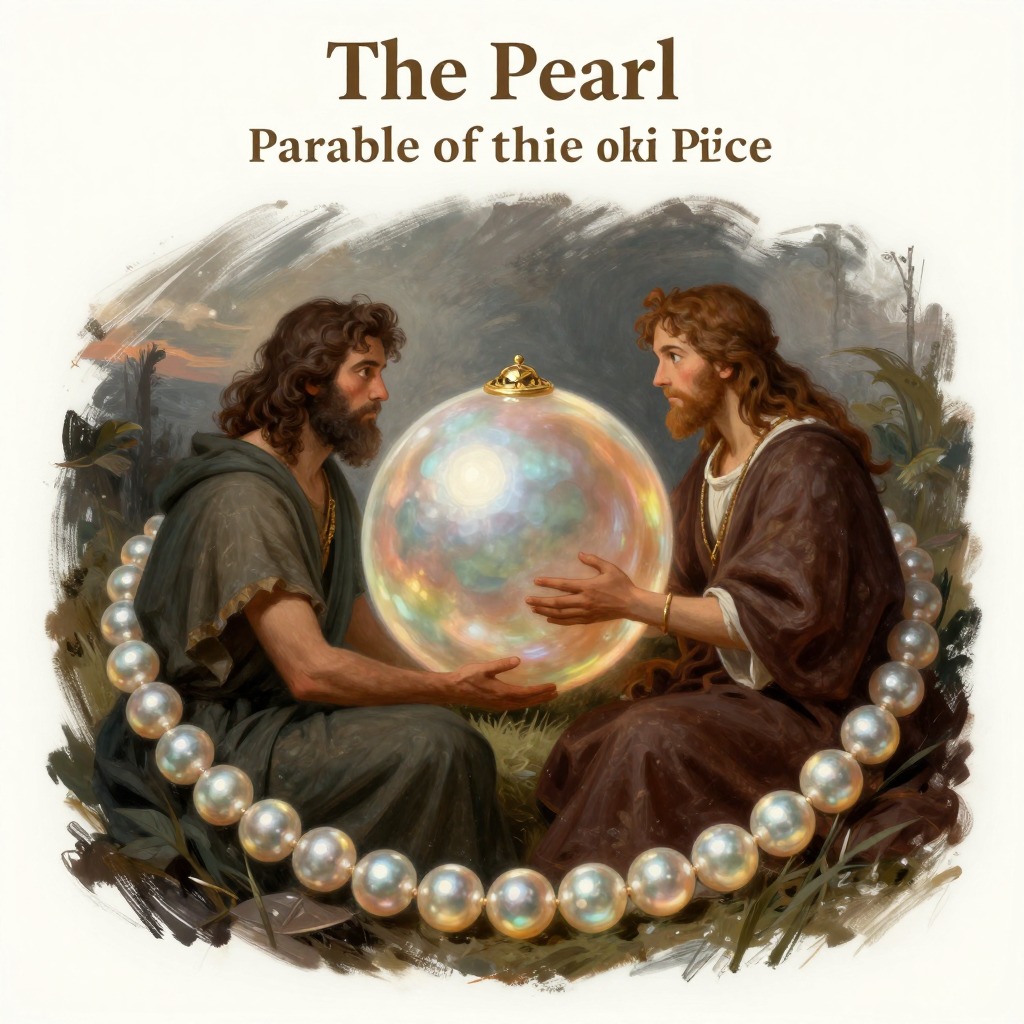
Discovery of the great pearl
The discovery of the great pearl is the pivotal event of John Steinbeck's novella, the moment that transforms Kino and Juana's simple, harmonious life into a desperate struggle against greed, violence, and fate. What begins as a stroke of luck—a pearl "perfect as the moon" and "as large as a sea-gull's egg"—quickly becomes an object of obsession, a catalyst for the town's collective avarice, and the instrument of the family's destruction. The finding of the pearl is not merely a fortunate accident; it is the point at which the Song of the Family is drowned out by the Song of Evil, and the dream of a better future curdles into a nightmare of loss.
The Dive and the Finding
Kino, his wife Juana, and their infant son Coyotito have just endured a crisis: a scorpion has stung the baby, and the town's doctor refused to treat him because they were poor. With the swelling on Coyotito's shoulder rising ominously, Juana prays not directly for the baby's recovery but that they might find a pearl with which to hire the doctor. Kino takes his canoe out to the oyster bed, a place that had once helped make the King of Spain a great power. As he dives, the Song of the Pearl That Might Be, a secret, sweet melody, plays in his head, stronger than usual because of the great need. Working deliberately, he selects the largest shells. Beside a hummock of rubbly rock, under a little overhang, he spots a very large oyster lying by itself, its shell partly open. In the lip-like muscle he sees a ghostly gleam before the shell closes. His heart pounds with a heavy rhythm as he forces the oyster loose and holds it tightly against his breast. Surfacing, he lays the oyster in the bottom of the canoe.
The Revelation of the Pearl
Back in the canoe, Kino is reluctant to open the oyster, fearing that what he saw might be a reflection or an illusion in the Gulf's uncertain light. Juana, her eyes on him, cannot wait. "Open it," she says softly. Kino slips his knife into the shell, works the blade lever-wise, and the shell falls apart. The lip-like flesh writhes and subsides. Lifting the flesh, he sees it: the great pearl, perfect as the moon, capturing light and giving it back in silver incandescence. It is the greatest pearl in the world. To Kino, the secret melody of the maybe pearl breaks clear and triumphant. In its surface he can see dream forms. He picks the pearl from the dying flesh and holds it in his palm, noting its perfect curve. Juana comes near to stare, and she sees it in the hand he had smashed against the doctor's gate, the torn knuckles turned grayish white by the sea water.
The Miraculous Healing
Instinctively, Juana goes to Coyotito and lifts the seaweed poultice from his shoulder. She cries out shrilly: the swelling is going out of the baby's shoulder; the poison is receding from his body. Kino's fist closes over the pearl, and his emotion breaks over him. He throws back his head and howls, his eyes rolling up, his body rigid with a scream. The men in the other canoes look up, startled, and race their paddles toward Kino's canoe. The pearl has not only been found; it has seemingly performed a miracle, healing the child the doctor refused to treat. This apparent blessing, however, is the seed of the tragedy to come.
The Pearl as a Symbol of Hope and Doom
In the immediate aftermath, the pearl becomes a vessel for Kino's most ambitious dreams. He sees in its incandescent surface a vision of his family being married in the church, wearing new clothes—Juana in a stiff new shawl and shoes, himself in a fine black felt hat and laced shoes, and Coyotito in a blue sailor suit. He sees a new harpoon, and then, breaking down all barriers, a rifle. Most powerfully, he sees Coyotito sitting at a desk in a school, reading and writing, learning the things in the books that will make them free. "This is what the pearl will do," Kino says, having never spoken so many words together in his life. But even as he speaks, he is afraid, and the music of evil, faint and weak, begins to sound in his head. The pearl, which Juana will later call "like a sin," has already begun to corrupt the world around them. The town's nerves pulse with the news, and every man suddenly becomes related to Kino's pearl, making Kino himself "curiously every man's enemy." The discovery of the great pearl is thus the moment of both supreme hope and the inexorable beginning of the family's descent into darkness, a descent that will end with a dead child and a pearl thrown back into the sea.